The Weight of Becoming
I've been thinking a lot about the impact of change, and how much is being asked of someone when they embark on their own transformation: starting therapy, engaging in embodied reconnection with the self, taking up space in the world.
In my somatic psychotherapy practice, I get to witness clients who are ready to shift their habitual responses to not only trauma, but life itself. To reclaim parts of their personal history, or experiences that have been forgotten or neglected. There's often a longing to move toward something more: a more dignified sense of self, a more authentic way of being in the world.
The Risk of Authenticity
And yet, that move toward authenticity can feel deeply unsettling, even frightening. Not because we're resistant or broken, but because change carries real risk. When you start to set clear boundaries, when you stop responding habitually to versions of yourself that others expect, when you step out of the role you've always played, whether as the people pleaser, the over-accommodator, or the one who keeps the peace, you begin to challenge the very dynamics that have organized your relationships. Transformation never stays contained to just one person.
The Loneliness Nobody Warns You About
This is where loneliness often creeps in. There are points in healing where we are actively rejecting norms that no longer feel supportive, where we're rethinking how to respond to exploitation, to boundary transgressions, or to a chronic sense of invisibility. Holding new boundaries, or refusing to play old scripts, can feel like loss. Maybe even a trap. Is it even worth it?
The Chrysalis Phase
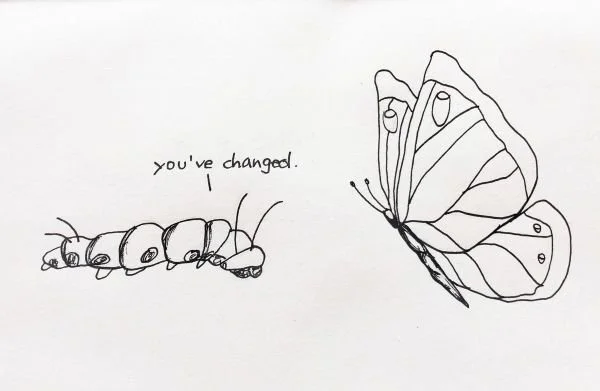
I think of the caterpillar that transforms into a butterfly. The caterpillar moves through the world content enough, doing what caterpillars do. But to become a butterfly, it must first form a chrysalis: entering a period of in-between, no longer one thing and not yet another. That liminal space is a real test of patience and faith. Inside the chrysalis, the caterpillar doesn't simply wait. It dissolves, breaking down almost entirely, before something new can form. It's hard to trust a form of safety your nervous system hasn't experienced yet. It's hard to believe you'll be met when you finally make room for your own authentic, dignified self, especially if you haven't experienced this before.
Dignity, Belonging, and Safety
This brings me to something foundational from my training in Generative Somatics, rooted in the work of Staci Haines. There is a tension, almost a rock-paper-scissors dynamic, between dignity, belonging, and safety. As social creatures, our need for belonging is a powerful attachment drive. So powerful that we will often place it ahead of our own dignity, or even our safety. The fear of rejection, abandonment, or exile can feel more urgent than the need to be true to ourselves.
This is especially resonant for 2SLGBTQ+ communities, where choosing authenticity can mean precisely that: exile. From family, community, religious or spiritual identity, or the very resources that sustain daily life. For many people, dignity, belonging, and safety genuinely cannot all be held at once. The stakes are not abstract.

Building from Dignity
And yet, something becomes possible when dignity leads. When we stop shrinking to fit and start asking who can actually hold all of us, we find that true belonging is a different thing entirely: messier, more negotiated, sometimes requiring the upheaval of old systems and inherited ways of being together. But it does not ask you to disappear in order to be welcomed.
All of this is to say: the healing journey is never only personal. It is rooted in both individual repair and the larger work of social justice, the collective project of building a world where everyone's experience has room to exist. These are not separate things; they are deeply interconnected. This is part of what trauma therapy and nervous system regulation are ultimately in service of, not just symptom relief, but a more dignified way of being in the world.
You Are Not Alone
So if you are in that chrysalis phase right now, where it feels lonely, where something true in you refuses to be ignored, and you're not yet sure how to reach for connection that will honour all of your core needs (belonging, dignity, and safety), trust that this is a temporary stage. This is the beginning of the journey, not the ending.
If you're navigating this kind of transformation and want support that holds the whole of you, I'd welcome the chance to talk. [Book a free 20-minute consultation.]