To Dance Is to Matter: A Somatic Psychotherapy Guide to Your Original Embodiment
There is a lot of talk about embodiment these days — in therapy rooms, wellness spaces, and of course somatic practices. It has become a word that signals our return to internal experience: what we feel, smell, touch, taste. And yet, the more we use it, the more I notice we've turned it into another abstract state to achieve. Another instruction. Be embodied. As if the body were a destination we need to arrive at.
And still, there is a reality to the instruction. The fact that we need to remind ourselves to breathe, to drop our shoulders — this tells us something. We are experiencing increasing disembodiment as dismemberment continues on actual human bodies — children and families murdered by drones and missiles, witnessed on tiny screens in clips too fast to feel before the next scroll begins. Unmoored, and somehow still expected to feel something appropriate about all of it.
This is not just information overload. This is a particular kind of disembodiment — one that has been designed. We are severed from material reality. It takes astronauts leaving Earth entirely to look back and remind us: this planet, this spinning rock, is a breathing, living thing. It is rare. It is sacred.
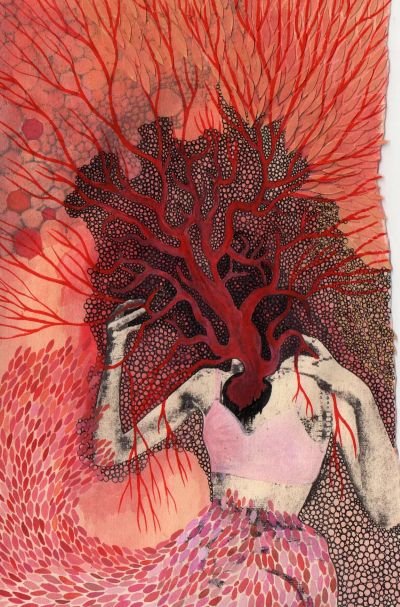
Image from : https://www.ashleyblanton.com/arteries
In these moments, I return to the original embodiment. Before promises of nervous system regulation, mind-body connection, or breathwork skills — we danced. In graduate school I encountered philosopher and movement scholar Kimerer LaMothe, whose philosophy of bodily becoming positions movement as the very source of human life. She describes our bodily rhythms — the pulse of blood, the expansion and collapse of breath — as continuous, generative movement. The body is constantly healing through rhythm. It always has.
Our first experience of the world was not thought, not language — it was a pulse. A felt sense of aliveness before words existed to name it. The first embodiment was the dance of creation, a heartbeat forming before there were words.
To dance is not a metaphor, not a therapeutic intervention. To dance is to matter. To dance is to exist.
Colonization did something particular to dance. It made it optional — a talent, a skill you possess or don't. The colonial gaze turned toward self-scrutiny: I can't dance. I'm not a dancer. As if rhythm were something some people possess and others lack, rather than the very thing that made us.
I remember a school trip to Dance Collection Danse (DCD) where I learned that the colonial project made this literal. Under the Indian Act beginning in 1884, Indigenous ceremony, song, and dance were criminalized. The Potlatch is one example — outlawed, with people arrested simply for participating, their ceremonial regalia confiscated and dispersed to collectors and museums worldwide. The embodiment of a people was so threatening it required the force of law to suppress. This is intergenerational trauma in its most explicit form — the severing of body awareness, of communal rhythm, of embodied social change passed down through generations of practice. To dance is to matter. To dance is to be human.
I spent decades on many sweaty dance floors — it was my ritual. These days it looks different. In post-partum life, I bounce my son at 2:30am, rocking him through humming and motion, trying everything to find the right rhythm to soothe him back to sleep. Babies need dance to return to safety, to trust that it is okay to settle. His nervous system regulation relies on the dance we do together. Dance is the language of survival — bottom-up, pre-verbal, older than any technique we've since named.
To return to dance is not to take a class or find a style. It is to remember that the body has been moving all along — toward healing, toward aliveness, toward meaning. Our work in somatic psychotherapy, sometimes, is simply to stop interrupting it.
We are living through genuinely difficult times. The interpersonal struggles we carry exist against a backdrop of what has become normalized oppression — a hijacked collective reality that makes it easy to forget your right to basic self-expression. Healing justice begins in the body. It is only the mobilization of movement that interrupts the freeze. The more we reconnect with the original dance within, the more we reclaim some part of us that even the most critical inner voices cannot suppress. To dance is to matter.
I've linked some resources below for those seeking community and embodied practice to support your return.
Further Reading & Resources
Why We Dance: A Philosophy of Bodily Becoming — Kimerer LaMothe The philosopher whose work threads through this newsletter.
Dance Collection Danse Canada's national dance archive, based here in Toronto. Their collection holds the history of dance on this land — including the colonial banning of Indigenous ceremony and movement.
The Potlatch Ban — U'mista Cultural Centre The community-led archive that holds the direct history of the ban, the arrests, and the fight to repatriate confiscated potlatch regalia. Primary source, told by the Kwakwaka'wakw themselves.
Movement Practices & Community
Continuum Movement A practice that works with the body's fluid intelligence — breath, wave, and subtle motion as a path back to aliveness.
The 360 Emergence A free-form movement practice that meets you exactly as you are, weaving personal healing with our collective and global reality.
5Rhythms — The Well A movement meditation practice that moves you through five rhythms — no choreography, no right way — just your body finding its own wave.