Beyond Self-Improvement: A Somatic Approach to Community as Health
In the era of self-improvement, this time of year often capitalizes on our insecurities and health complexities.
The wellness industrial complex thrives by manufacturing illusions of our not-enoughness. As a somatic psychotherapist, I’m willing to include navel-gazing forms of psychotherapy in this critique as well—when self-work becomes overly focused on analysis and insight while neglecting the body’s need for co-regulation, creativity, nature, and collective belonging.
I continue to witness an over-pathologizing of mental health that strips our experiences from the context of how our lives are actually lived. The isolation many of us feel—from our creativity, from the living world, and from one another—often goes unnamed. Boundaries meant to enrich connection are used instead to avoid depth, leaving us quick to label others as “toxic” or “narcissistic” rather than practising the skills required to sustain real relationship.
In doing so, we miss a profound opportunity for aligned connection, one that can support us through the bumpy realities of post-capitalist life.
My wish for you this year is simple: to cultivate community. To invest in relationships that help you become more of yourself—relationships that inspire, support, and challenge you.
I know this can feel daunting, especially if you’ve been unseen or harmed in past relationships.
Capitalism trains us to equate productivity with worth, leaving vulnerability without obvious returns feeling risky. Add AI and manufactured realities, and it’s no wonder familiarity feels safer than trust.
And still, community remains one of the most potent antidotes we have.
What follows is a guide to help you enrich your human relationships this year.
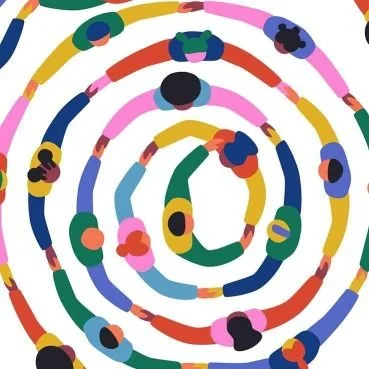
Step 1: Name your existing resources (nature & all beings)
Begin with an environmental scan. Where do you feel most at ease—or least activated? Where do you feel most like yourself?
This might be in nature, with a pet, in a familiar café, or in a quiet corner of your home. Take a moment to name the places, plants, and beings (human and otherwise) that allow you to soften, breathe more easily, and simply be.
How much time do you spend with these resources? Can you expand or prioritize them?
If you’re not ready for deepening your human relationships yet, that’s okay. Start with what reconnects you to your sense of being. Being able to notice when you are most present, will help inform which relationships and their context you want to invest in.
Step 2: Notice where safety and ease already exist
Reflect on which relationships offer you the most safety and ease.
We often default to the people we know best or see most frequently—but looking back on 2025, which interactions brought lightness to your being?
They don’t need to be deep or long-standing. Sometimes it’s a brief exchange, a neighbour, a colleague, or a group you visited once.
Notice your somatic experience.That is tracking what happens in your body in their presence. More breath? More humour? More honesty? Less bracing?
Sometimes newer relationships give us permission to be seen differently—to meet ourselves in a new light. This can be a powerful place to begin.
Step 3: Cultivate connection
Connection requires vulnerability—and yes, it can also involve the risk of rejection.
Start with the relationship(s) where you already felt permission to be yourself. Then ask: where might I find more of this quality of connection?
People who can meet us this way already exist, but connection often asks us to initiate.
Initiation doesn’t need to be elaborate. It can be as simple as:
“I really enjoyed spending time with you and would love more of that in 2026.”
From there, create an opportunity. Invitation is a form of care.
Some ways to initiate:
Invite someone for a walk, tea, or a shared meal
Suggest a recurring ritual (monthly coffee, seasonal check-in, a movement or creative practice)
Attend an event together and name your intention to connect more deeply
Start something small: a reading group, a creative date, a co-working afternoon
Follow up after a meaningful interaction instead of letting it fade
Share a value or curiosity and ask if they’d like to explore it together
Not every invitation will land…and that’s not a measure of your worth. What matters is practising the muscle of reaching toward connection rather than waiting to be chosen.
….If you’re still unsure where to start
You may simply need more exposure to different kinds of people and spaces. Community rarely appears fully formed. It grows through presence, repetition, and choice.
This doesn’t need to be immediate or intense, but it does require commitment. Not to outcomes, but to showing up.
Over time, the quality of your well-being becomes inseparable from the quality of your connections. We don’t regulate, imagine, or heal in isolation—we do so in relationships.
A few myths about community-building
Myth 1: You need a large circle
You don’t. Community doesn’t require a crowd. As Tricia Hersey of The Nap Ministry reminds us, rest, care, and belonging are built through depth, not scale. One or two reliable relationships or a recurring shared space can be enough.
Myth 2: Community should be convenient
Community is often inconvenient. It asks us to show up when we’re tired, to adjust our schedules, and to be impacted by others. We have to participate in the village to create the village. Mutual care is shared relational labour.
Myth 3: Intimacy equals “trauma dumping”
This myth has done real harm. Intimacy doesn’t mean oversharing or bypassing consent—it means relational vulnerability. Naming what’s alive in your heart or mind, while staying attuned to the capacity of the space, is not pathological—it’s human. You are allowed to be in relationships that make you feel seen, safe and witnessed in all your imperfect parts.
Resources to begin exploring community in Toronto/GTA
Meetup Toronto – Diverse groups for social, creative, and professional connection
https://www.meetup.com/find/ca--on--toronto/Creative Mornings – A global community centred on creativity, belonging, and connection
https://creativemornings.comCity of Toronto Drop-In Programs – Arts, movement, and interest-based programs across the city
https://www.toronto.ca/explore-enjoy/parks-recreation/program-activities/arts-hobbies-interests/drop-in-arts-hobbies-interests-map